Before buying lift kits and truck accessories in Reading, choose between a leveling system and a complete suspension lift. A leveling kit corrects factory rake while preserving daily manners, and a suspension lift adds clearance, wheel travel, and bigger tire options. Collect exact year, trim, drivetrain, and suspension details to confirm Rough Country fitment. Plan for tires, alignment, and add-ons like steps, lights, or liners—you'll understand how the ideal setup develops.
Key Takeaways
- Opt for a leveling system to address factory rake while maintaining near-stock performance and enabling slightly larger tires for routine driving.
- Pick a suspension lift for more clearance, suspension travel, and off-road capability, knowing steering and handling may shift.
- Confirm proper fitment by verifying your truck's year, make, model, drivetrain, trim, cab, bed, and suspension package before ordering Rough Country products.
- Pair lift height and shock setup to your driving style, whether commuting, doing trail work, towing, or serious off-road travel.
- Budget for more than the kit cost, including alignment, labor, wheels, tires, shocks, and supporting accessories like steps, lights, and liners.
Suspension Lift Kits vs Leveling Kits
Even though both enhancements modify your truck's stance, suspension lift kits and leveling kits solve different problems and give different outcomes. A leveling system tends to raise the front to match the rear, rectifying factory rake with limited change to geometry, ride height, and daily drivability. You select one when you want a cleaner look and room for slightly larger tires.
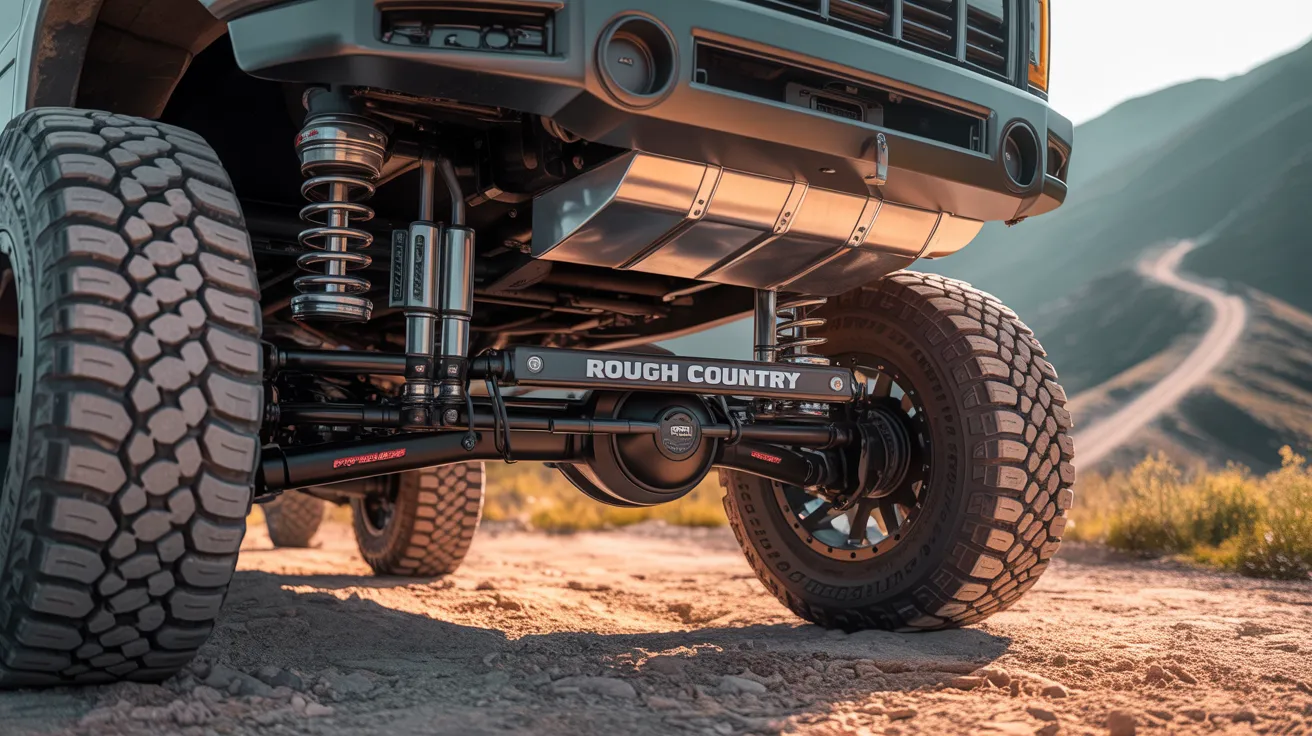
A suspension lift kit raises the whole truck and changes key components to produce more ground clearance and suspension travel. You'll see bigger gains in ride height, off-road capability, and tire fitment, but you should anticipate handling tradeoffs, steering changes, and a higher center of gravity. If you want subtle visual improvement, level it. If you need real clearance and articulation, use a suspension lift and plan the supporting modifications based on your needs.
Find the Rough Country lift kit that matches your truck.
Begin by recording your truck's year, make, and model, drive configuration, and planned purpose, because Rough Country manufactures lift kits based on specific platform requirements and performance goals. That information shows which mounting hardware and suspension elements can bolt on without spacing or alignment conflicts.
Subsequently, verify original ride height, cab and cargo layout, axle setup, and if your truck runs 2WD, 4WD, or adaptive suspension. Rough Country compatibility guides streamline this process, yet you should confirm read about this component compatibility against trim-level hardware and factory package variations. A kit designed for a Silverado 1500 might not work with a Trail Boss, and a Ram featuring air-spring suspension demands different modifications compared to a coil-spring vehicle. By confirming compatibility first, you sidestep unexpected problems, parts conflicts, and return delays.
Determine which Rough Country lift kit fits your driving habits.
Pair the kit with your actual driving habits, and you'll achieve enhanced ride quality, lasting performance, and tire space without purchasing unnecessary capability. If your truck spends most days commuting, go with a mild Rough Country leveling kit or a 2 to 3.5 inch lift kit calibrated for daily comfort and predictable steering geometry.
When you divide time between road and off-road use, step up to a lifted suspension that includes improved shocks and adjusted control arm geometry. You'll enjoy better trail handling, better articulation, and space for bigger tires without straining OEM components. For extensive off-road use, select lifted struts, N3 and Vertex dampers, and lifts that maintain driveline geometry during compression. A quality Rough Country package needs to match load, speed, terrain, and your tolerance for ride stiffness.
Leading Rough Country Truck Accessories
Enhance your lifted truck by adding Rough Country aftermarket items that fix the genuine problems you'll discover after the lift, new tires, and stance change. Go with upgraded steps or skid plates, which regain cabin access and offer lower-body protection now that your truck sits higher and broader.
Next, address view and handling. Rough Country light systems increase sight lines on night trails, work sites, and country roads without hard-to-manage integration. Cabin protection and cargo liners keep safe inside surfaces from soil, gravel, and water you'll carry in after off-roading. Fender flares manage tire spray and complement the wider look created by bigger rubber. For towing or pulling, reinforced hitches, towing accessories, and bumpers that support winches contribute capability without affecting fit. Go with add-ons that complement your truck's new profile and load capacity.
How Much Should You Budget for Your Build?
After you've selected the lift kit and supporting accessories, create a budget exceeding the listed kit price. You'll need funds for shocks, wheels, tires, wheel alignment, labor, and any drivetrain or steering upgrades your vehicle requires. Brand reputation plays a role here; premium systems tend to deliver better precision, better ride quality, and fewer install headaches.
Regarding realistic budget ranges, anticipate basic spacer or leveling kits to start at lower prices, while full suspension systems with control arms, tuned dampers, and larger tires increase fast. Install complexity, labor costs, and calibration work can add substantially. You should also price supporting upgrades like gear changes, brake components, and recovery gear if you're building for trail use. When budget is tight, assess payment alternatives carefully and prioritize consistency rather than fancy extras.
Popular Questions About Lifts
Will Lift Kits Change My Factory Warranty?
Yes, lift kits can affect your factory warranty coverage, but they won't automatically cancel it. You face warranty implications if a dealer proves the suspension modification led to or contributed to a failure. Engine, steering, suspension, and drivetrain issues often spark dealer disagreements. You should keep installation records, use quality components, and follow service intervals. That helps you challenge rejected claims and protect coverage in cases where the modification isn't responsible.
Do Bigger Tires Mean Re-Gearing?
Yes—when you upgrade several tire sizes, you'll usually need re-gearing. Take switching from 31s to 35s, for example—your vehicle can feel sluggish, shift awkwardly, and build drivetrain stress with cargo. Re-gearing recovers optimal gear ratios, helping you recover power delivery, towing capacity, and transmission feel. You might not need it for small tire changes, but if power, MPG, or shifts worsen, it's usually the right call.
What's the Inspection Schedule for Lift Kits?
You should inspect lift kit components once you hit 500 miles, afterwards at every oil change or 3,000 to 5,000 miles, depending on your usage. Regular maintenance checks enable you to catch bushing wear, shock leaks, bracket damage, and alignment issues early. Verify fastener tightness after hard off-road runs, towing, or impacts. If you drive in muddy, salty, or challenging terrain regularly, tighten inspection schedules and examine suspension and steering parts at faster intervals.
Does a suspension kit impact your vehicle's towing and payload limits?
Yes, a lift kit can change your towing and payload capacity. When you boost ground clearance for improved clearance, you adjust suspension geometry, center of gravity, and leverage on components. That can lower stability under load and increase drivetrain stress, mainly with larger tires. You should follow your maker's specs unless an factory-engineered kit formally documents revised capacities. Proper alignment, gear selection, and brake performance matter too.
Should Alignment Services occur after installing truck accessories?
Yes—if accessories change ground height, suspension geometry, steering alignment, or tire dimensions, you require an wheel alignment. You'll feel the theory fast: minor adjustments can pull your truck off-center, scrub tread, and compromise handling. A correct alignment restores camber angle, caster angle, and toe angle to specification. After certain installs, you might require brake calibration for driver assistance precision. You preserve tire longevity, steering precision, and actual safety by checking alignment immediately.
Conclusion
Choosing the proper lift configuration and products relies on how you use your truck, your preferred stance, and your cost capacity. When you tune a Rough Country lift kit to your driving style, you'll experience performance, clearance, and looks that work together like a well-tuned drivetrain. Add smart accessories, structure your spending carefully, and you'll develop a rig that's suitable for highways, formidable on trails, and equipped for anything next.